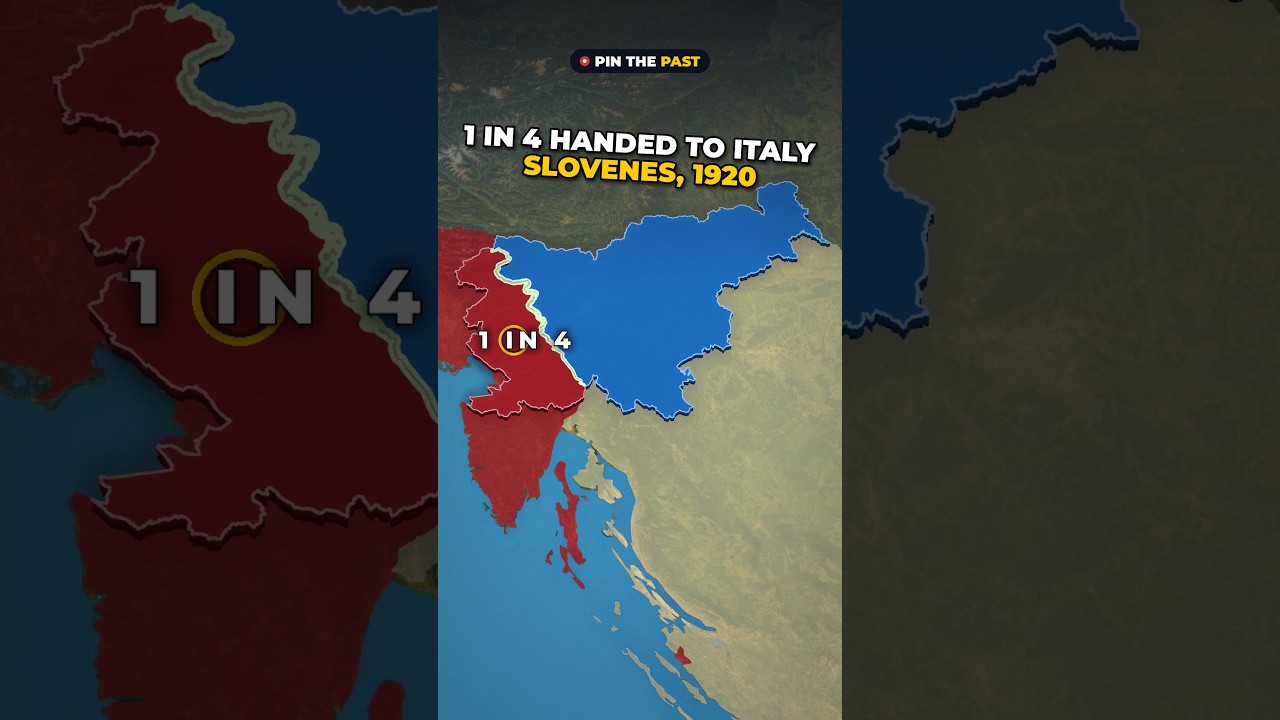
Aproximadamente uno de cada cuatro eslovenos terminó en Italia en 1920, en virtud de un tratado firmado por el nuevo reino de los eslovenos. ✍️ En 1918 los eslovenos abandonaron Austria-Hungría en el Estado de los Eslovenos, Croatas y Serbios (29 de octubre), y el 1 de diciembre de 1918 les siguió el Reino de los Serbios, Croatas y Eslovenos (llamado Yugoslavia desde 1929). Su provincia gobernada desde Ljubljana se llamó Eslovenia (Deželna vlada za Slovenijo, 1919-21). Italia se había unido a la Primera Guerra Mundial después del Tratado secreto de Londres (26 de abril de 1915), en el que Gran Bretaña, Francia y Rusia le prometieron Trieste, Gorizia, Istria y la Carniola occidental, además del norte de Dalmacia. Después del armisticio de Villa Giusti (3 de noviembre de 1918), su ejército entró: el destructor Audace desembarcó tropas en Trieste ese día. El presidente estadounidense Woodrow Wilson calificó el acuerdo de Londres como inválido y su línea de 1919 habría dejado Idrija y el este de Istria en manos del reino. Luego, el 2 de noviembre de 1920, Warren Harding ganó las elecciones presidenciales de Estados Unidos y el apoyo estadounidense a las ideas de Wilson parecía haber terminado (Kernek, 1982; Burgwyn, 1997). Gran Bretaña y Francia habían presionado al reino desde la primavera de 1920 (Repe 2008). Así, el reino (Milenko Vesnić, Ante Trumbić, Kosta Stojanović) e Italia (Giovanni Giolitti, Carlo Sforza, Ivanoe Bonomi) firmaron en Rapallo el 12 de noviembre de 1920. Italia obtuvo Trieste, Gorizia, Istria, Postojna e Idrija, hasta Snežnik, además de Zadar y cuatro islas, y Fiume (Rijeka) se convirtió en un estado libre hasta Italia. lo anexó en 1924. Eso dejó alrededor de 327.000 de aproximadamente 1,3 millones de eslovenos en Italia, aproximadamente uno de cada cuatro (Cresciani 2004; Lipušček 2012), más que los 302.971 habitantes de Pittsburgh (censo de 2020). Las fuentes eslovenas dan entre 290.000 y 350.000, y el censo de Italia de 1921, que preguntaba por el idioma de uso diario, contaba menos. Los eslovenos venecianos, en Italia desde 1866, no se cuentan entre los 327.000; Los eslovenos del sur de Carintia son 1,3 millones, y su zona votó el 59,1% por Austria el 10 de octubre de 1920. Después de la Segunda Guerra Mundial, la mayor parte de esa tierra pasó a Yugoslavia (1947), pero Gorizia siguió siendo italiana y Trieste pasó a Italia en 1954. Hoy en día, Eslovenia cubre 7.827 millas cuadradas (20.271 km²), un poco más pequeña que Nueva Jersey, con una extensión de 29 millas. (47 km) de costa. Su capital, Liubliana, es la ciudad natal de la estrella de los Lakers, Luka Dončić. La opinión: muchos eslovenos llaman a Rapallo «el tratado que dividió a los eslovenos» (RTV Slovenija), una cuarta parte de la nación firmada por su propio Estado bajo presión. Muchos italianos ven a Italia recuperada: la promesa de 1915, Trieste y Gorizia con sus centros de habla italiana y unos 650.000 soldados perdidos en la guerra, muchos de ellos en el Isonzo; Rapallo también eliminó a Dalmacia de Londres, excepto Zadar. Unos 180.000 croatas también fueron a Italia y Trumbic, que firmó, era croata. Los historiadores ven una línea trazada por los tratados, el poder y la presión, no por el idioma: las ciudades hablaban italiano, la mayoría de los pueblos esloveno o croata, y nadie allí votó. En julio de 1920, escuadrones nacionalistas quemaron el Salón Nacional de los Eslovenos (Narodni dom) en Trieste; En su centenario, el 13 de julio de 2020, los presidentes de Italia y Eslovenia vieron firmado un protocolo para devolverlo. En el vídeo: el destructor Audace en Trieste (3 de noviembre de 1918), las dos delegaciones en Rapallo (12 de noviembre de 1920) y el retrato de Wilson de Harris & Ewing de 1919. 📍 Pin The Past: historia mundial explicada en un mapa satelital animado, un lugar a la vez. Suscríbete: @PinThePast Fuentes: Tratado de Rapallo (1920); Tratado de Londres (1915); Cresciani (2004); Lipusček (2012); Kernek (1982); Burgwyn (1997); Repé (2008); Mirković (hrcak.srce.hr); INZ (ojs.inz.si); RTV Eslovenia; Parque vojaške zgodovine; ISTAT; SURS; Libro de datos mundial de la CIA; Oficina del Censo de EE.UU.; esteri.it; STA; euronoticias; ABC7; Wikipedia (Tratado de Rapallo, cuestión del Adriático, minoría eslovena en Italia, plebiscito de Carintia de 1920, Salón Nacional de Trieste). Créditos: Imágenes: Sentinel-2 sin nubes – por EOX IT Services GmbH (Contiene datos modificados de Copernicus Sentinel 2016), CC BY 4.0; Mármol azul de la NASA; datos de mapas © Colaboradores de OpenStreetMap (ODbL); fronteras históricas: colaboradores de OpenHistoricalMap (CC0; de alguna manera CC BY 4.0), Natural Earth (dominio público); fotografías: Regia Marina, el destructor Audace en Trieste (3 de noviembre de 1918); fotógrafo desconocido, las delegaciones en Rapallo (12 de noviembre de 1920); Harris & Ewing, Woodrow Wilson (1919, Biblioteca del Congreso), todo de dominio público; música: «Contemplación» de Joth (OpenGameArt.org), CC0 1.0. #Eslovenia #Italia #Croacia #historia #Trieste #Gorizia #Istria #Ljubljana #Rapallo #WW1 #Europa #geografía #mapas #cortos
Otros sitios web de nuestra empresa para que los visite:a mayor selección de Camisetas de fútbol baratas está en eBay ✓ Compra equipaciones de fútbol y más al mejor precio ✓ ¡Con opción de envío gratis
Italy already has too much land, they should give back Trst to Slovenia
trst je naš
ITALIAN LAND
Gorizia and Trieste have historically been Italian cities, never part of Slovenia, while the surrounding rural provinces had a mixed, patchwork distribution of Italian and Slavic populations.
Starting in 1866, the Austro-Hungarian Empire actively promoted a policy of forced Slavicization to weaken the Italian presence. In the Crown Council of November 12, 1866, Emperor Franz Joseph explicitly ordered: "That decisive action be taken against the influence of the Italian elements still present in some Crown lands and, by suitably filling the positions of public officials, judicial officers, and teachers, as well as through the influence of the press, efforts be made in South Tyrol, Dalmatia, and the Littoral for the Germanization and Slavicization of said territories depending on the circumstances, with energy and without any regard." This policy culminated in the Hohenlohe Decrees of August 1913, which purged thousands of Italians from public offices in Trieste.
Even in northern Istria, the coastal towns and major centers had an overwhelming Italian majority. At the Paris Peace Conference in 1919, President Woodrow Wilson applied his Fourteen Points on self-determination selectively against Italy, ignoring the exact same principles elsewhere: he left the Chinese region of Shandong under Japanese control, ethnic-German Danzig separated from Germany, and Albanian-majority Kosovo—as well as Macedonia—under Serbian rule.
Finally, after World War II, the Western Allies left Istria and Dalmatia in the hands of Tito’s communist regime. Tito’s Yugoslav forces—including the Slovenian IX Corps—occupied these lands and carried out systematic massacres (the Foibe) and the forced exodus of nearly 350,000 ethnic Italians, a tragedy that is still too often omitted from mainstream narratives.
Greetings
Wtf is a Slovenians Kingdom? Slovenia never existed in history, untill Serbs marched in,in 1918 and literally gave them autonomy.
Serbs couldn’t do anything to keep those territories after WW1. Same with Carinthia.
True 300k are more sloves than there are slovenes in pittsburgh
Stupid Italy 😂 always gain land although lose
I dont recognise Italy as Rome Successor
Slovenian Kingdom?
The inland is mostly Slovene, but the coast had been majorly populated by venetians for centuries.
Trieste was never Slovenian although it's true that you just need to move a couple km to be in fully Slovenian lands
It was said that the diplomat representing Italy wept and cried in tears when he found out Italy was not getting for what it was promised for for joining the Allied side of the war. Instead getting less for what they were promised.
Servus,unsere Slowenien❤❤❤ Grüße aus Pliberk
Pittsburgh mentioned rahhhh!!⚫️🟡⚫️🟡⚫️🟡🏈🏈
Pls remember the number of italian people that were obliged to leave the territory given to Slovenia in 1945
Slovenes did not gift territory to the Italians!
During the time of the Kingdom of SHS, the Serbs exchanged territory. They acquired Dalmatia—excluding Zadar—in exchange for western Slovenia, including Istria!
It is Serbs who liberated Slovenia and died for it, both in WWI and WWII. Plus saved tens of thousands of Slovenians expelled by Nazis in 1941 to central Serbia.
Yugoslavia was an artificial state, like Czehoslovakia. Both don't exist today!! Ukraine and Great Romania are also artificial states! … they were put together from neighboring countries (like Transylvania was befor for 1000 years Hungarian). How dare English and French politicians decide about millions of European lives without considering History, Ethnicity, and Self-determination?! It is Western, democratic ignorance, arrogance, brutality!
L’Istria è italiana!
The significance of the EU also lies in its approach to minorities, as national borders do not coincide with ethnic boundaries. Often, populations along borders are ethnically mixed. Read the Slovenian anthem.
Northern italians arent italian
And there were Italian in those land befor ww1 and during a massive immogration of sloven and croat pour in istria during the first workd war itaian in istria were displace and istria was rapidly cleance by austoungarian empire to avoid italian support in the reagion after austria defeat the italian came back and grew but yougoslavia and italy started fighting terorist war in the reagion and aroud after the defeat of yugoslavia as befor barbarossa the balcan region grew in civil war betwen ustacha comunist monarchist and local group italian trope were dispach to end the blodshed but they coudnt eliminate the partisan and civil war only grew until almost the entire souther slavic population was coinvolt in action still german in minor and italian in major held civil autority togheder this change whit italian armistice and surrender hundred of thousend of troops in the baəcan doing military policing were disbanded and there was no garantee of peace there so the fight only grew after the comunist of tito won the civil war they occupied most of istria and kickt all of latin population and germanic whit the lesast of force but whit military treath so the region become fully slavic only after the second world war befor the cost was of the original latin decendent of roman epire and the interəand were slavic tribe setle after hunnic invasion
For years now, thanks to the European Union and Treaty of Schengen, going from Slovenia to Trieste seems like walking to school literally, everyone is free to go and leave. It is one of the best examples of the Schengen Treaty in this context.
It would make no sense to claim a city just to see it on the national map…
Запад не успокоится ,пока не уничтожат славян .Но скорее произойдет обратное
Slovenia is a fake country. It should had been Austrian after WW1. Most people there wanted exactly that
Slovenia newer was a kingdom or ondependent state before Yugoslavian komunist!
nie oddało –tylko im to ukradziono ,a to ogromna różnica